


The complete guide
Downpipe Leaf Guards, A Practical Buyer's Guide
The problem starts at one small hole
Gutters are long and open, so they look like the vulnerable part of the system. They are not. The weak point is the outlet, the single hole at the end of the run where everything funnels down into the downpipe. It might only be 50mm across. Every leaf, seed pod, twig and clump of roof grit that lands in your gutter eventually drifts toward it.
A few leaves wash through. Then one gets sideways, another lands on top, moss and grit bind them together, and within a season you have a plug that behaves like a cork. The gutter fills, water backs up and spills over the front lip in a sheet. You see stained render, rotting fascia boards, puddles against the footings, and sometimes damp coming through where the roof meets the wall.
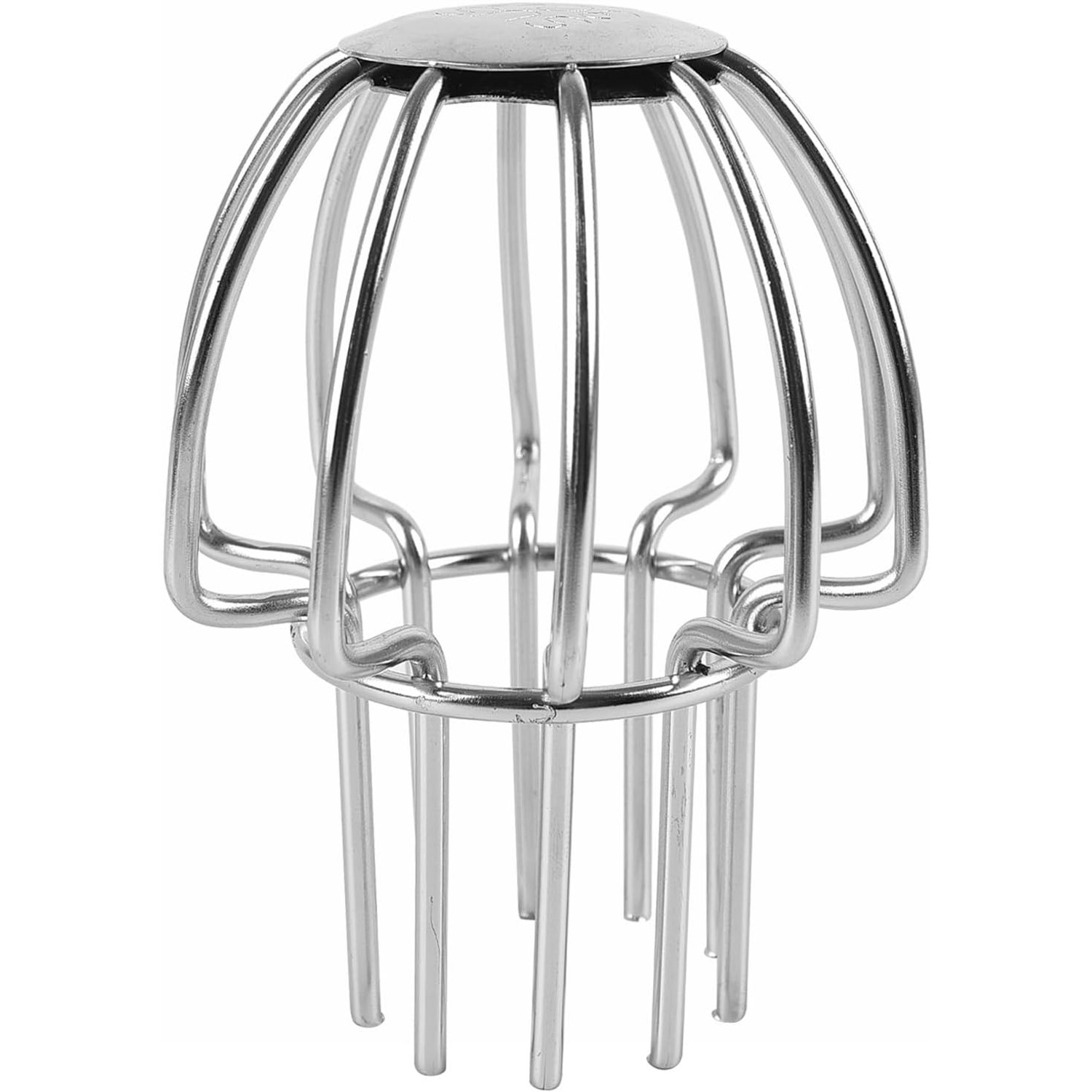
A downpipe leaf guard is the small part that keeps that from happening. It is not clever technology. It is a shaped stainless steel mesh that sits in the hole and holds debris on the outside while water goes through.
How a balloon strainer works
The older style of outlet screen was a flat disc. The trouble with flat is obvious once you have seen one in autumn. Leaves land on it, cover it completely, and now you have a solid lid. Water sits on top, the gutter fills, and the guard has made things worse rather than better.
A balloon or dome strainer solves that with geometry. Only the narrow base sits in the pipe. The rest rises into the gutter as a curved cage. Leaves can only sit where gravity puts them, which is on the top and the upstream side. That leaves open mesh on the downstream side and all the way around the lower curve. Water that pools in the gutter finds those open sections and drains.
It still fills eventually. Nothing is maintenance free when you have trees overhead. But the dome buys you a lot of time, and more importantly it fails slowly rather than suddenly. A flat screen goes from fine to fully blocked in one windy afternoon.
Why stainless steel matters here
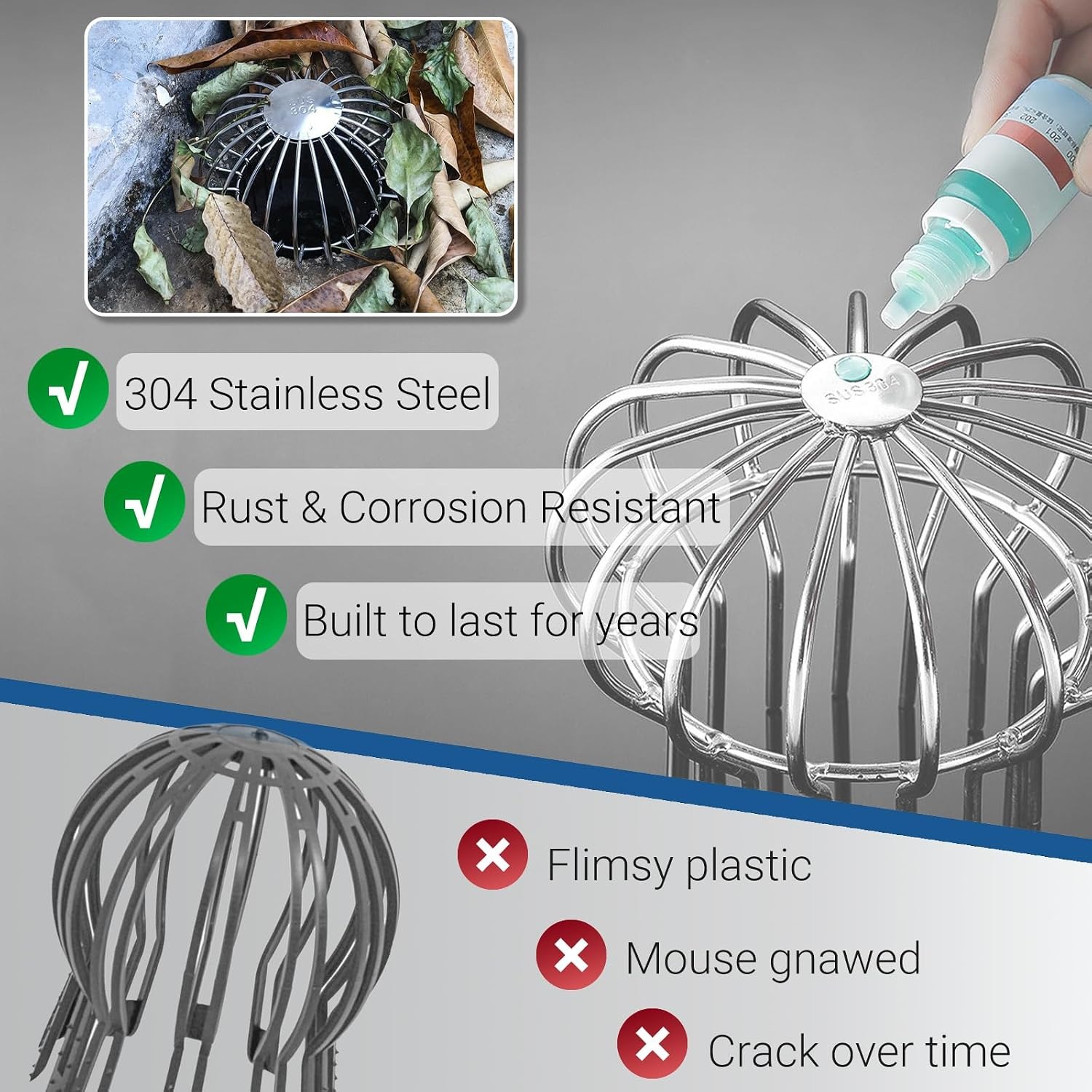
This guard is 304 stainless steel. That is worth caring about for a part that lives outside permanently.
Plastic guards are cheaper. They also sit in direct sun, which makes them brittle over a few summers. The first time you pull one out to clean it, the edge snaps. Then the broken piece washes down the pipe, which is exactly what you were trying to prevent.
Galvanised steel is tougher but the coating can wear where the mesh rubs against the pipe. Once it wears, rust follows, and rust stains run down the outside of the downpipe.
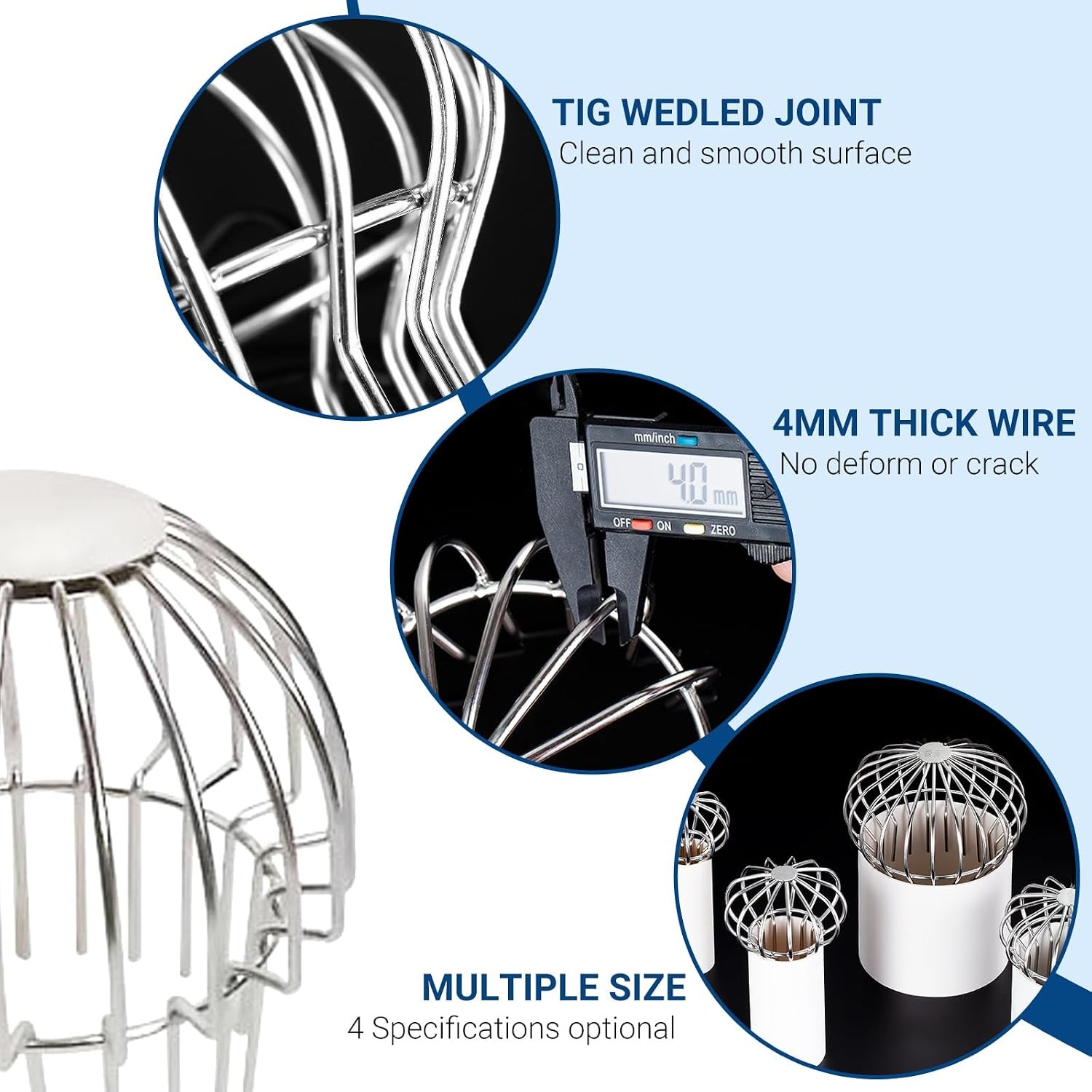
304 stainless resists corrosion and oxidation through constant wet, frost and heat. It holds its shape when you squeeze it to clean it, and it goes back in the hole looking the same as the day it arrived. For a part you want to fit once and forget, that is the right trade.
Getting the size right
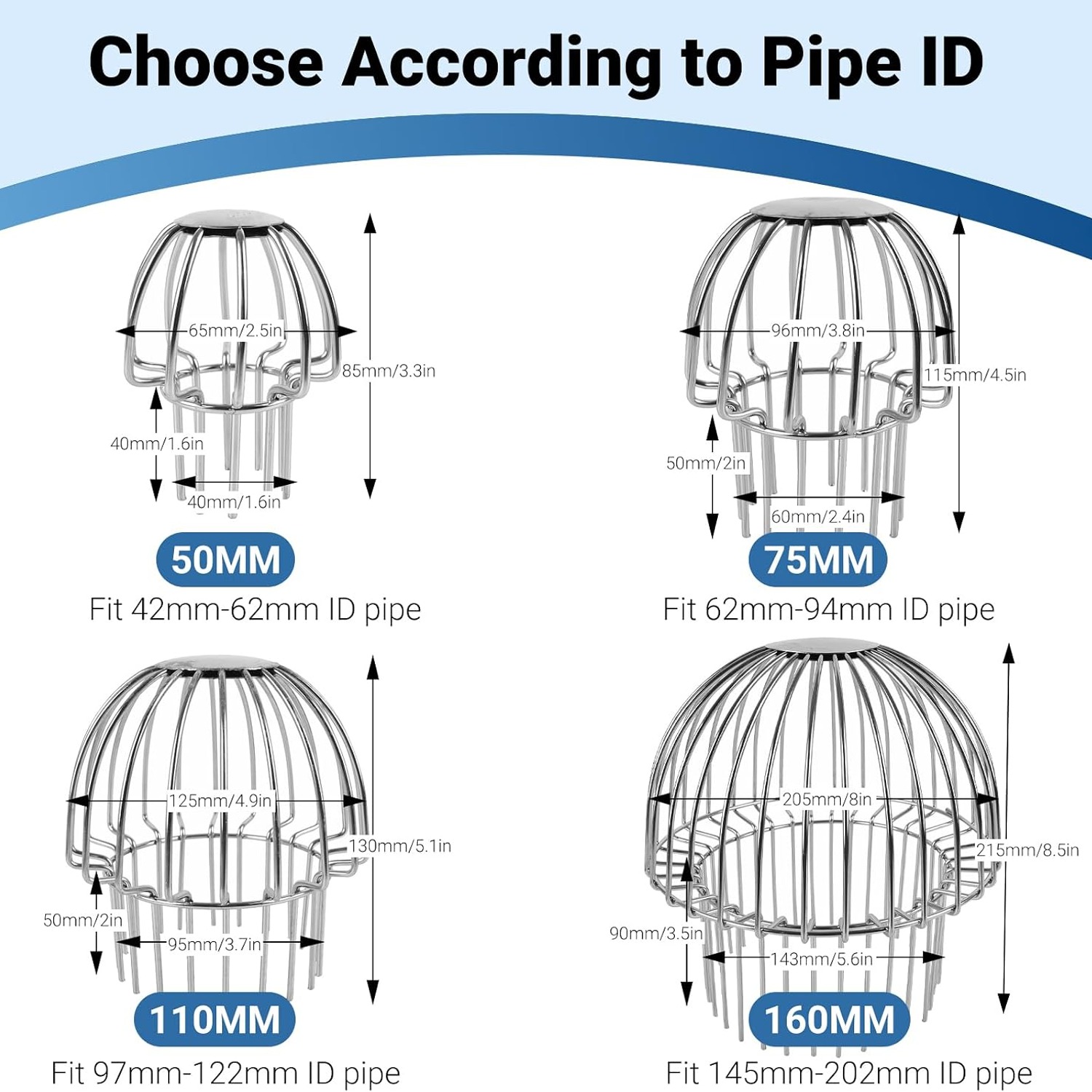
This is the one step people rush and regret. The size on this product is 42-62mm.
Measure the inside diameter of the opening, not the outside of the pipe, and work in millimetres. If the outlet has a lip or a spigot moulded into the gutter, measure the narrowest point the guard has to sit in. Take the measurement at two angles, because older pipes are not always perfectly round.
A guard that is too small will drop straight through and end up in the downpipe. One that is too large will perch on top, get knocked loose by the first heavy rain, and wash into the gutter where it blocks the channel. Neither failure is dramatic, but both mean another trip up the ladder.
One honest caveat. Half-round gutters sometimes do not suit this design, because the outlet sits in a curved floor rather than a flat one and the base of the guard cannot seat evenly. If you have half-round gutters, look at how the area immediately around the outlet is shaped before you order.
Fitting it
There is no assembly. It arrives as one moulded piece with no screws, clips or glue.
Clear the gutter first. There is no point sealing fresh debris into the system. Scoop out the sludge, flush the run with a hose, and check the water actually drains before you fit anything. If the pipe is already partly blocked lower down, a guard at the top will hide the problem rather than fix it.
Then push the base of the guard into the outlet until it seats. It should feel snug and stay put when you give it a light tug. That is the whole job.
Ladder sense applies. Work on firm level ground, keep three points of contact, and move the ladder rather than leaning out sideways. If your gutters are above single storey height or the roof is steep, this is a reasonable job to hand to someone with the right access gear.
Who this suits
Houses with trees nearby are the obvious case. Gums, plane trees, liquidambars and anything that drops seed pods are the worst offenders because the debris is small enough to travel and stiff enough to lock together.
It also suits anyone who has had a nesting problem. Birds and rodents treat an open downpipe as a ready-made tunnel. A mesh dome in the opening shuts that door without harming anything.
Beyond roofs, the same strainer does a job on balcony floor drains, flat roof outlets, garden drainage lines and sewer pipe openings, anywhere a pipe in the right diameter range is exposed to falling debris and loose soil. On balconies it is useful for a different reason, catching the grit and hair that would otherwise build up in a hard-to-reach bend.
It is less useful if your gutters are already fitted with full-length mesh covers. In that case the channel is protected and the outlet rarely sees much. Some people still fit one as a second line, which is a reasonable belt-and-braces approach but not essential.
Keeping it working
A guard that is never checked is just a slower blockage. Build it into whatever rhythm you already have.
In most places, twice a year works. Once before the wet season and once at the end of autumn. If you have heavy tree cover, go quarterly. The signal that you are overdue is water running over the front of the gutter during rain, or a gutter that stays wet for days after a storm.
Cleaning is simple. Lift the guard out, tip the dry leaves into the garden or bin, brush the mesh if sludge has set in it, and rinse with the hose if needed. Push it back in. If it has been squashed, press it gently back toward its original shape before refitting rather than jamming it in misshapen.
Do not paint it, coat it or wrap it in anything. The steel is doing its job as it is, and a coating only gives water somewhere to sit.
The short version
The outlet is where gutters block, and a dome-shaped stainless mesh strainer is the cheapest way to stop it happening. This one is 304 stainless steel, weighs 90 g, comes as one piece with no tools required, and fits openings from 42mm to 62mm.
Measure your pipe first. Order one per downpipe. Clear the gutter before you fit it. Then check it twice a year and empty it when it fills.
That is the entire commitment, and it replaces a job that otherwise involves a ladder, a bucket and a wet arm up a blocked pipe.